

Is Your ESD Workstation Protecting the Entire Process?
A properly designed ESD workstation protects more than the primary work surface. Effective ESD control should account for personnel, shelves, storage, tools, accessories, packaging, carts, monitoring, ionization, and every point where an ESD-sensitive product is handled.
An ESD workstation can look properly equipped and still contain gaps.
The work surface may be grounded, but sensitive components are placed on an ungrounded shelf. An operator may wear a wrist strap, while insulative packaging sits only a few inches from the product. A workstation may have been installed correctly, but accessories, carts, bins, or cleaning products have changed over time.
Effective ESD control requires more than checking a few products off a list. It requires looking at the workstation as part of a larger system.
Why Is a Grounded ESD Work Surface Not Enough?
A grounded ESD work surface is an important part of an ESD-protected workstation, but it does not protect every location, material, or person that interacts with an ESD-sensitive product.
Electrostatic discharge can become a risk anywhere sensitive components are handled, stored, transferred, inspected, tested, repaired, or packaged.
That means ESD control may need to extend beyond the main worksurface to include:
- Personnel grounding
- Shelves and storage
- Bins and parts containers
- Carts and mobile equipment
- Tools and fixtures
- Packaging materials
- Continuous monitors
- Ionization
- Grounding points
- Testing and verification procedures
ANSI/ESD S20.20 provides a framework for establishing an ESD control program to protect electrical and electronic parts, assemblies, and equipment that are susceptible to electrostatic discharge damage.
The workstation is one part of that system.
How Should You Evaluate ESD Risk at a Workstation?
The best place to begin is with the actual process, not with the furniture or ESD products already installed.
Before choosing a bench, mat, monitor, grounding accessory, or ionizer, follow the product through the workflow.
Ask:
- Where is the ESD-sensitive product received?
- Where is it unpacked?
- Where is it assembled or repaired?
- Where is it inspected or tested?
- Where is it stored between operations?
- How is it moved between work areas?
- Where is it packaged?
- Which employees handle it?
- Which tools, fixtures, bins, carts, and accessories come into contact with it?
A well-designed ESD workstation supports that real workflow while making proper ESD procedures easier for operators to follow consistently.
If the process requires parts to move from the bench to a shelf, then to a cart, then to an inspection station, each of those locations needs to be considered as part of the ESD control process.
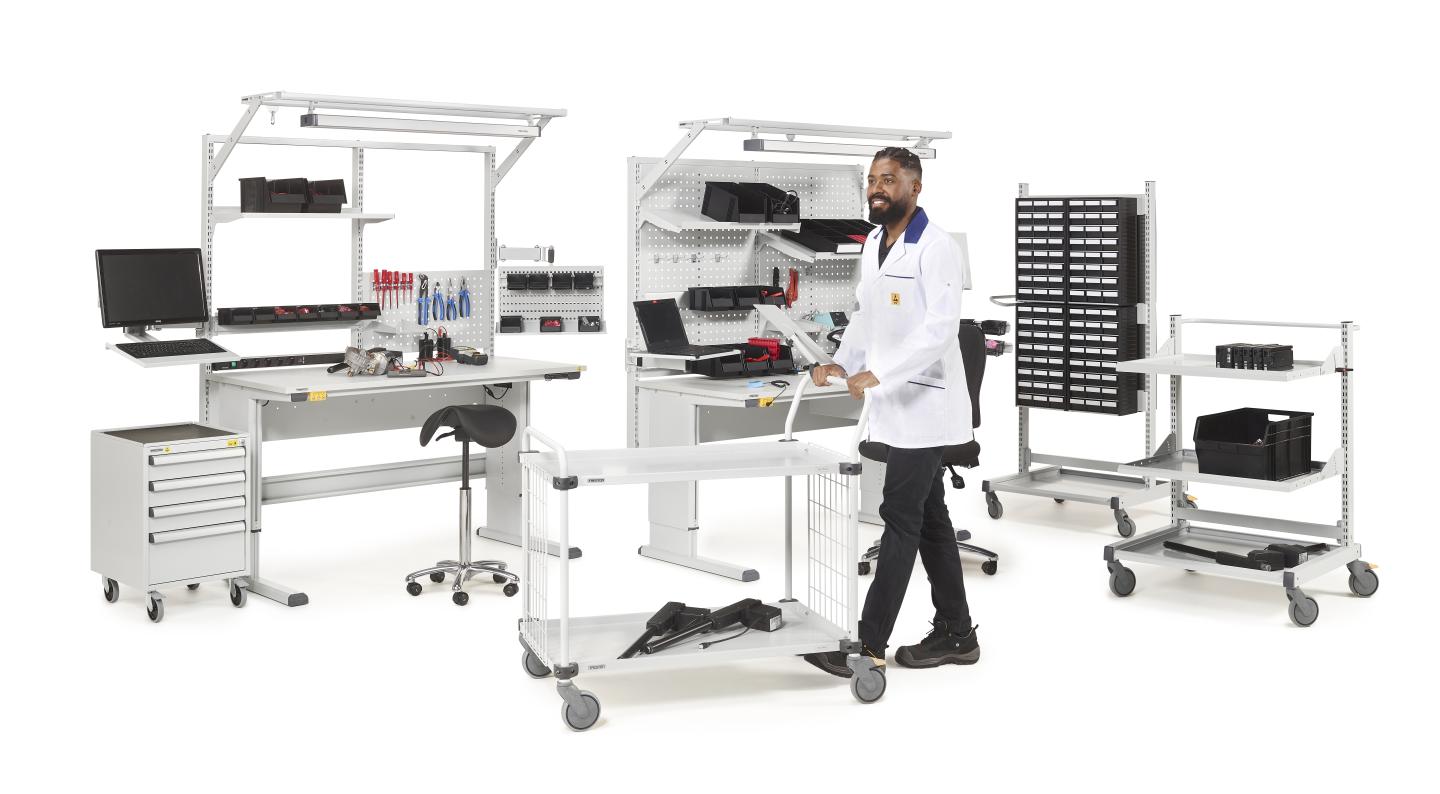
What Areas of an ESD Workstation Need Protection?
Personnel Grounding
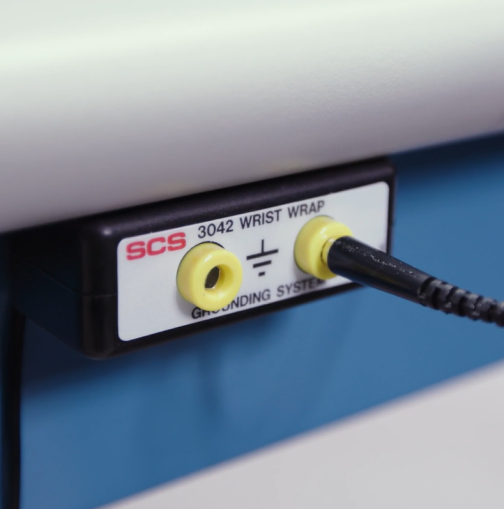
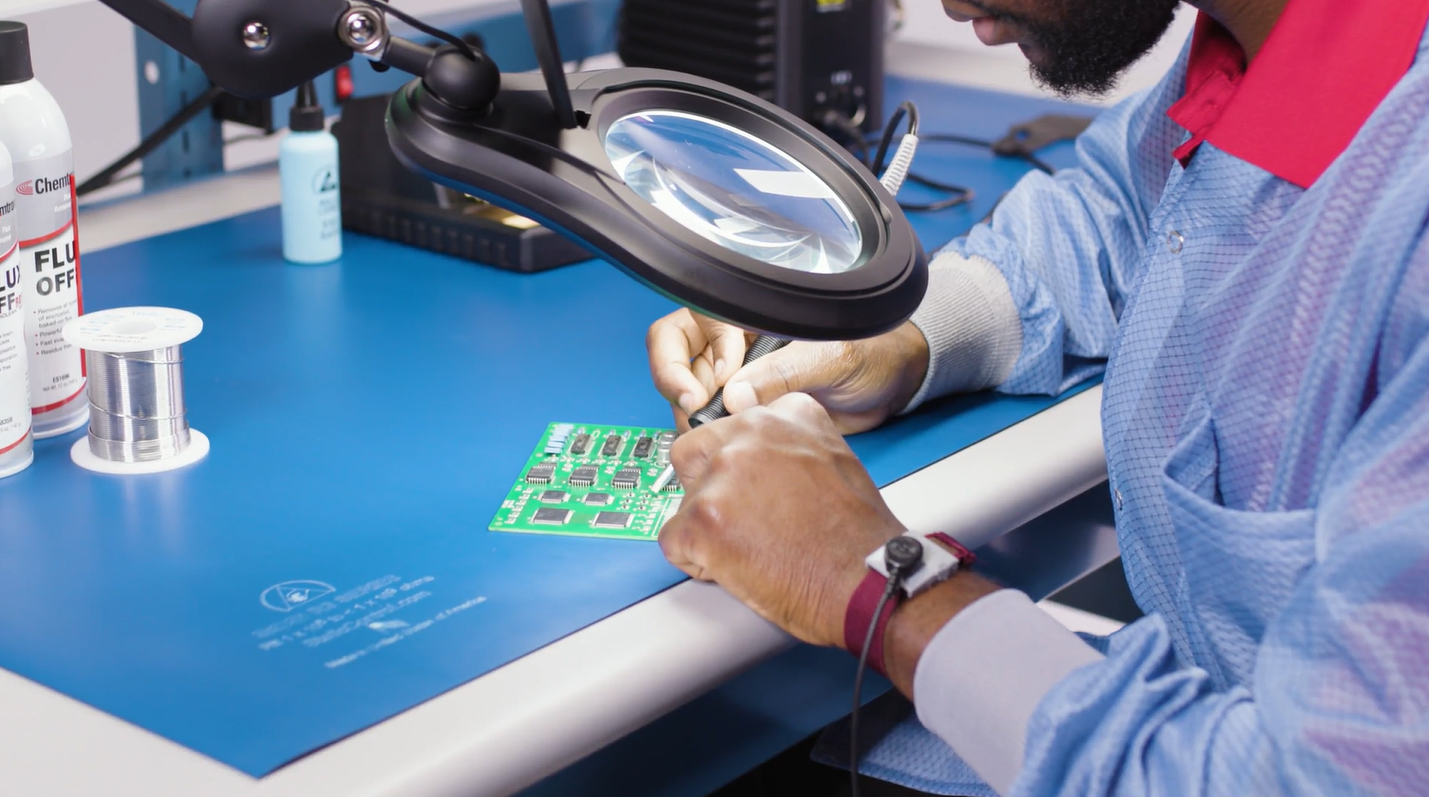
Personnel grounding helps control electrostatic charge generated by the people handling ESD-sensitive products.
Depending on the ESD control program and work environment, this may include wrist straps, footwear systems, ESD flooring, or other personnel-grounding methods.
The workstation should make the required grounding method easy to use correctly. Ground points should be accessible, cords should be routed so they do not interfere with work, and the operator should not have to choose between following the ESD procedure and performing the task efficiently.
ESD Work Surfaces and Shelving
The entire product-handling area should be considered, not just the primary worksurface.
An ESD-sensitive product may move between the main bench, shelves, storage areas, fixtures, and nearby accessories throughout the workday.
If the main worksurface is ESD-protected but an accessory shelf is not part of the protected system, the product may leave the controlled area every time it is moved.
This is one reason workstation design matters. Shelving and accessories should be selected and installed with ESD performance in mind rather than treated as unrelated additions after the workstation is in place.
Storage, Bins, Carts, and Racks
ESD-sensitive products frequently move away from the workstation during storage and transport, so mobile and storage equipment should also be evaluated.
Common areas to review include:
- Parts bins
- Shelving
- Drawers
- Mobile carts
- Racks
- Inspection stations
- Packaging areas
- Work-in-process storage
A grounded workstation cannot compensate for an uncontrolled container or cart used elsewhere in the process.
Continuous Monitoring
Continuous monitors provide ongoing verification of critical elements of the ESD control system rather than relying only on periodic checks.
Depending on the monitor and workstation configuration, continuous monitoring can verify personnel grounding, the path to ground of the work surface, grounded tools, or multiple elements at the same time.
For example, Treston offers the WS Aware Dual-Wire Monitor as part of its ESD control solutions. The monitor continuously checks the path-to-ground integrity of two operators, two conductive or dissipative work surfaces, and two metal tools. SCS states that the monitor meets ANSI/ESD S20.20 requirements in accordance with ESD TR1.0-01-01. Source: SCS
The WS Aware Monitor also provides Ethernet connectivity to the SCS Static Management Program. Through that system, data can include operator resistance and voltage, mat resistance, metal-tool impedance, and EMI voltage. The monitor can also alarm when an operator generates or contacts voltage that could be dangerous to an ESD-sensitive item.
For organizations handling ESD-sensitive products continuously or operating higher-reliability processes, this type of monitoring adds real-time verification to the workstation rather than depending entirely on periodic testing.
Ionization and Insulative Materials
Grounding is highly effective for conductive materials, but not every source of electrostatic charge can be grounded.
Insulative materials may retain charge because there is no conductive path for that charge to dissipate.
Unlike conductive and static-dissipative materials, insulators cannot be discharged by grounding because they do not provide a conductive path for the charge to flow away. When an insulator is essential to the process and cannot be removed or replaced, ionization can be used to neutralize the electrostatic charge. Ionization can also control isolated conductors that cannot be properly grounded. Source: Desco, ESD Awareness Booklet, pp. 8 and 13.
Common examples may include certain packaging materials, plastics, labels, tapes, fixtures, or other materials required by the process.
When necessary insulators cannot be removed from the protected area, ionization can be used to help neutralize electrostatic charge.
The goal should always be to first identify which materials are present and whether they are actually required in the process.
Testing, Cleaning, and Verification
An ESD-protected workstation should continue to perform as intended after installation.
Workstations change over time.
Accessories are added. Shelves are moved. Different bins appear. Cleaning products change. Employees begin using new equipment. Carts are reassigned from another department.
Routine testing and verification help confirm that those changes have not introduced new ESD risks.
An ESD control program may therefore include:
- Resistance testing
- Ground verification
- Personnel-grounding checks
- Continuous monitoring
- Worksurface testing
- Inspection of accessories and storage
- Cleaning procedures
- Periodic ESD audits
The goal is not simply to create an ESD-protected workstation once. It is to maintain the integrity of the protected system as the process evolves.
Treston's qualified ESD workstation products are supported by product-specific ESD certificates that customers can use as part of their equipment documentation and verification process.
Common ESD Workstation Gaps
Many ESD workstation problems are not caused by the primary bench itself. They occur when other elements of the process are added or changed without considering their effect on ESD control.
Common examples include:
- A grounded worksurface paired with an uncontrolled shelf
- An operator using a wrist strap while parts are placed in ordinary bins
- Insulative packaging brought inside the protected work area
- Mobile carts that are not properly integrated into the ESD control process
- Accessories added to the workstation without considering their ESD performance
- Necessary insulators present without appropriate ionization
- Ground cords that are disconnected, damaged, or difficult for the operator to use
- Cleaning products or procedures changed without verifying compatibility with the ESD worksurface
- The ESD mat is too small for the actual working area, leaving sensitive devices unprotected.
- A workstation that was properly configured when installed but has not been reevaluated after the process changed
These are exactly the kinds of gaps that can be missed when ESD control is treated as a checklist of individual products rather than as a coordinated system.
What Is Treston ESD Proof by Design™?
Treston ESD Proof by Design™ is our approach to designing workstations specifically for ESD-controlled environments from the beginning rather than adding ESD protection as an afterthought.
Treston ESD workstations are engineered specifically for applications where electrostatic discharge control is part of the process. Our engineers intentionally select and design workstation components to comply with applicable ESD requirements and to function together as part of a controlled workspace.
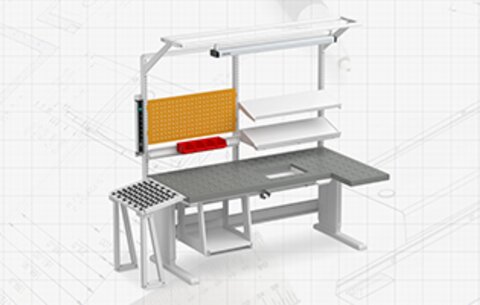
That includes consideration of the workstation frame, worksurface, uprights, shelves, accessories, grounding, and other elements that make up the complete workstation.
Qualified Treston ESD products are supported by ESD certificates documenting their ESD performance, giving customers verification that the products have been designed and tested for use in controlled environments.
Designed for Controlled Environments
Treston does not simply take a standard industrial bench and label it as an ESD workstation.
Our ESD products are intentionally designed for environments where electrostatic discharge control matters, including electronics manufacturing, semiconductor, aerospace and defense, medical device manufacturing, testing, repair, and other ESD-sensitive processes.
That means ESD performance is considered during product development, not after the workstation has already been designed.
Selected Treston workstation configurations are suitable for cleanroom environments up to ISO Class 6.
A Conductive Workstation Structure
On applicable Treston ESD workstation systems, ESD-compatible finishes and components allow the workstation frame, uprights, shelves, and accessories to function together as part of the protected structure.
This can reduce the need to treat every component as a separate grounding problem and can create a cleaner, easier-to-inspect ESD workstation.
The exact grounding method depends on the workstation configuration, flooring, accessories, and ESD control program, which is why the complete application should always be considered.
ESD Certificates Provide Verification
Treston provides ESD certificates for qualified ESD workstation products.
These certificates document product performance and provide customers with supporting information for their own ESD control programs, quality systems, and internal documentation.
For organizations working in regulated or high-reliability environments, that documentation can be an important part of specifying and verifying workstation equipment.
How Does Workstation Design Support ESD Control?
Good workstation design makes proper ESD procedures easier to follow by organizing the protected work area around the operator, the task, and the materials being handled.
Operators are more likely to follow ESD procedures when the workstation supports the way they actually work. This is where ergonomics and ESD control often overlap. If an employee has to reach awkwardly for a frequently used part, move a monitor out of the way, stack materials on the worksurface, or relocate tools because there is no appropriate storage, the workstation itself may encourage behaviors that make the ESD control process harder to maintain.
Desco recommends removing unnecessary insulators from the ESD-protected workstation. When an insulator must remain, its ESD Awareness Booklet recommends keeping it at least 12 inches away from ESD-sensitive items, replacing it with an ESD-protective alternative where possible, or using another appropriate control method. Source: Desco, ESD Awareness Booklet
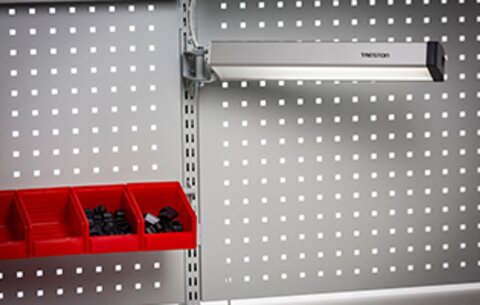
Shelves, bin rails, tool holders, monitor arms, and accessory systems can help maintain that protected area by keeping frequently used items accessible without crowding the worksurface or placing uncontrolled materials too close to sensitive products.
When process-essential insulators cannot be removed or grounded, ionization can be used to neutralize electrostatic charge. Ionization supplements grounding rather than replacing it.
A properly configured workstation should help the operator do the right thing naturally. With Treston ESD Proof by Design™, ESD performance is considered from the beginning so grounding, material placement, storage, ionization, and verification can be integrated into the normal workflow.
Design the Workstation Around the Entire ESD Process
An effective ESD workstation protects the product throughout the process, not only while it is sitting on the main worksurface.
Start with the workflow.
Follow the product.
Identify every location where it is handled.
Then evaluate the personnel, furniture, storage, grounding, monitoring, ionization, tools, accessories, packaging, carts, and verification procedures that interact with that process.
Treston's ESD Proof by Design™ approach starts with that same philosophy: ESD protection should be intentionally designed into the workstation system from the beginning.
The result is not simply an ESD bench.
It is a workstation designed to support the people, products, procedures, and controls that make up a complete ESD-protected work environment.
Learn More: ESD Control Made Simple
Building a successful ESD workstation requires expertise in more than workstation design.
That is why Treston works with ESD specialists and partners who bring additional expertise in grounding, monitoring, ionization, verification, auditing, and ESD control-program development.
In our ESD Control Made Simple: Practical Insights for Building a Successful ESD Workstation webinar, experts from Treston, SCS, Desco, and Quantum Systems share practical guidance on building and maintaining an ESD-protected workspace.
The webinar covers topics including:
- ESD grounding fundamentals
- Workstation design
- Personnel grounding
- Continuous monitoring
- Ionization
- ESD mats and worksurfaces
- Common implementation mistakes
- Practical lessons from real ESD environments
Together, the workstation and the ESD control products should function as one coordinated system.
Register for ESD Control Made Simple >
Explore Treston ESD Control Solutions >
Presented by